Apartment Fireplace Selection Guide
Best fireplace for an apartment: water vapor, electric, or smart ethanol?
There is no single best fireplace for every apartment. The correct choice depends first on building permission and the purpose of the fireplace, then on available wall depth, electrical capacity, ventilation, service access, heat management, noise tolerance, and the owner's willingness to maintain water or fuel systems.
Direct answer
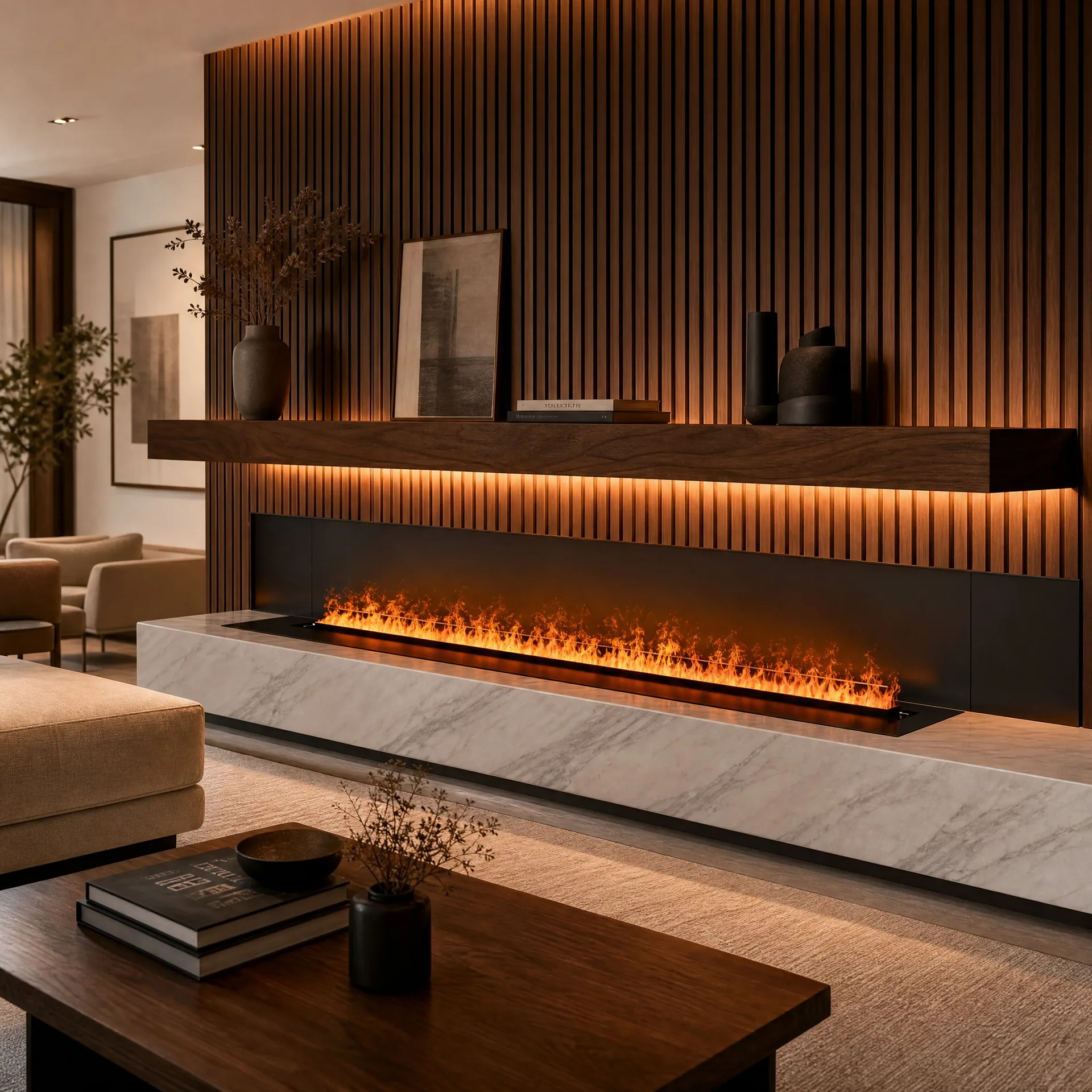
For an apartment where the main objective is a convincing decorative flame with no fuel combustion, a 3D water vapor fireplace is usually the strongest starting point. It can create a long linear feature below a television or within a joinery wall without introducing a real flame. It still requires electrical power, water management, adequate installation depth, and a service plan.
For a rental or a room where supplemental heat is the priority, an electric fireplace is often the most straightforward category. It avoids liquid fuel storage and can be treated more like an electrical appliance, subject to circuit capacity, heater clearances, fan noise, and landlord approval.
For an owner-occupied premium apartment where authentic flame is non-negotiable, a smart ethanol fireplace may be suitable. It is not the default answer for every apartment. It introduces real combustion, heat, fuel storage, refill procedures, and a greater need to verify room conditions, clearances, operating instructions, building rules, and destination-market requirements.
Apartment fireplace comparison
| Decision factor | Water vapor | Electric | Smart ethanol |
|---|---|---|---|
| Flame type | Illuminated water mist | LED, screen, or reflected effect | Real ethanol flame |
| Combustion in room | No | No | Yes |
| Primary value | Architectural flame effect | Simple installation and optional heat | Authentic flame and radiant warmth |
| Typical planning needs | Power, water method, drainage if specified, service access | Power load, heater clearance, fan noise | Permission, ventilation review, clearance, fuel handling |
| Best apartment use | TV wall, show flat, luxury living room, lobby | Rental, bedroom feature, supplemental heat | Approved premium owner-occupied project |
| Frequent mistake | Closing the wall without maintenance access | Ignoring circuit load or fan sound | Treating real flame as an unrestricted decorative object |
Step 1: define what "best" means for the apartment
Many poor specifications begin with a photograph rather than a performance brief. A designer sees a long flame under a television and asks for the same appearance, but the reference may show gas, ethanol, electric projection, or illuminated mist. Those systems have different heat behavior, depths, service requirements, and approval paths. Before selecting a model, write down the required outcome.
- Atmosphere only: prioritize visual quality, silence, service access, and low operating complexity.
- Supplemental heat: define the desired heat contribution and available electrical capacity instead of assuming every fireplace is a room heater.
- Real flame: confirm that the building and local authority allow the intended appliance and fuel before designing the enclosure.
- TV feature wall: coordinate fireplace heat behavior, television position, recess depth, ventilation openings, and access panels as one assembly.
- Show apartment or sales suite: prioritize repeatable presentation, staff operation, cleaning, and reliable daily use.
The selection should also reflect who controls the property. A homeowner may approve permanent joinery and accept routine maintenance. A tenant usually cannot. A developer may need the same detail repeated across dozens of units, which makes installation tolerance, spare parts, and written handover more important than one dramatic rendering.
Step 2: obtain building approval before fixing the design
Apartment buildings can impose restrictions beyond city or national rules. Management may prohibit open flame, combustible-liquid storage, changes to common ventilation, penetrations through fire-rated walls, or high-load electrical appliances. Sprinklers, smoke detection, insurance conditions, evacuation routes, and lease terms may also affect the project. A supplier cannot approve those building-level questions from a room photograph.
Ask the owner, landlord, building manager, designer, and relevant authority to confirm the permitted fireplace category. Record the answer in the project brief. For a real-flame appliance, include the exact product type rather than asking a vague question such as "Can we have a fireplace?" A building may treat a fixed controlled appliance differently from a portable tabletop fire product, but that distinction must be confirmed rather than assumed.
The U.S. Environmental Protection Agency explains that combustion appliances can produce indoor pollutants and that the result depends on the appliance, fuel, installation, maintenance, and venting. Its overview of combustion products is a useful reason to treat ventilation and operating conditions as specification inputs, not afterthoughts.
Water vapor fireplaces: usually the first decorative option
A water vapor fireplace uses atomized water and controlled lighting to make mist appear flame-like. Because the effect does not burn fuel, it avoids the open-flame and fuel-storage questions associated with ethanol. This is why vapor systems are frequently considered for apartments, media walls, hospitality interiors, and sales suites where visual impact matters more than heating.
That advantage does not make every vapor unit interchangeable. The project team should compare flame density, viewing distance, LED arrangement, operating noise, water quality requirements, refill method, overflow strategy, drainage, power supply, control method, and access to atomizers and internal components. A narrow opening may look elegant but become expensive to service if the finished wall traps the unit.
SEFIRE separates the Primary water vapor series from the Deluxe water vapor series because their water and lighting systems serve different project levels. The correct comparison should use the current technical sheet and approved drawing, not only the series name. Designers can also use the installation planning checklist to capture opening dimensions, water access, drainage expectations, power, and maintenance clearance before cabinetry is released.
Water vapor should not automatically be described as a humidifier. It does introduce water mist into the visual effect, but the influence on room humidity depends on unit output, operating time, room volume, and ventilation. For a moisture-sensitive interior, ask for model-level water consumption and operating information and review it with the project engineer.
Electric fireplaces: practical when heat and simplicity matter
Electric fireplaces cover a broad category. Some prioritize a flame image; others combine the image with a resistance heater and fan. They can be useful in rental apartments, compact bedrooms, and renovation projects where liquid fuel is unsuitable. They do not create combustion products in the room, but they remain electrical and heating appliances when a heater is fitted.
Electric resistance heaters convert electrical energy into heat, but that simple operating principle does not make every installation interchangeable. For an apartment project, the practical checks are the product's rated input, the capacity and protection of the intended circuit, plug or hardwire requirements, heater outlet location, clearance from finishes, and whether fan sound is acceptable in a quiet living room or bedroom.
An electric fireplace may be easier to approve than real flame, but it can still fail as an interior product if the flame image looks artificial, the fan is intrusive, or replacement requires dismantling the media wall. Request an operating video, sound information where available, installation drawing, warranty terms, and access method. Do not select solely from the front elevation.
Smart ethanol fireplaces: authentic flame with stricter conditions
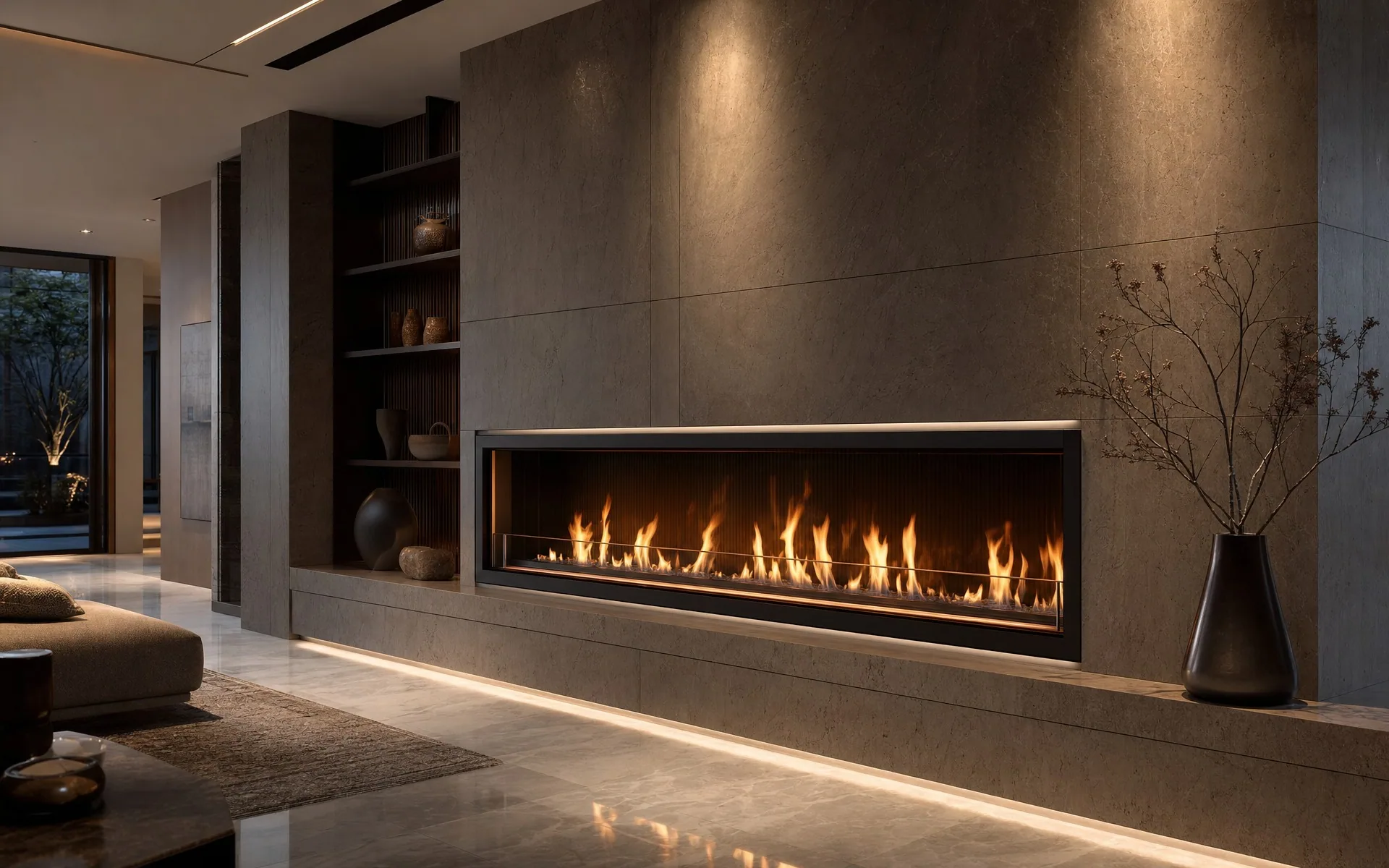
Smart ethanol fireplaces burn ethanol and therefore provide real flame and real heat without a conventional wood-burning chimney. Automated ignition, controlled fuel delivery, flame adjustment, remote operation, and model-specific safety monitoring can make a fixed smart burner more controllable than a simple open manual tray. Those functions do not remove combustion or eliminate the need for correct operation.
The U.S. Consumer Product Safety Commission has warned against alcohol fire pits that burn pooled liquid in an open container and can create flame-jetting hazards during refilling. The warning specifically discusses hazardous portable or tabletop-style products and open-container refilling. Read the CPSC alcohol fire pit alert. It should not be carelessly presented as proof that every fixed smart ethanol appliance is identical, but it is strong evidence that product architecture and refill procedure matter.
For an apartment, request the exact operating and refill sequence, required clearances, minimum room or ventilation conditions where specified, electrical requirements, fuel specification, installation drawing, and emergency shutdown behavior. Verify claims against the delivered manual and nameplate. SEFIRE's technical data policy explains why signed quotations, approved drawings, delivered manuals, and nameplates take precedence over a general website summary.
When wall depth is limited, compare the RCFB Slim series with the RCFB Regular series. Slim does not simply mean "better for every apartment." Reduced depth can affect capacity, proportions, installation details, or available model range. Select by the approved dimensions and project requirement.
Step 3: coordinate the wall, television, and service route
The fireplace is only one component in a feature wall. The designer must coordinate the finished opening, noncombustible or permitted surrounding materials, structural support, power connection, ventilation openings where required, water or fuel access, television position, cable route, speakers, cabinetry, and removable service panels. A visually centered layout can still be technically poor if the burner cannot be removed or the control box is sealed behind stone.
For a television wall, do not use a universal vertical distance copied from another brand or another fireplace technology. Obtain the heat and clearance information for the exact model. Water vapor systems generally reduce the real-flame heat issue, but the unit may still have lighting, electronics, mist discharge, and required airflow. Electric heaters can discharge hot air from the front or top. Ethanol flames introduce genuine heat. The complete assembly must be reviewed.
Measure net available depth after allowing for wall build-up, brackets, cables, stone, framing, and access. Compare that number with the full product envelope, not only the visible burner width. Use SEFIRE's fireplace project brief to send room type, country, wall dimensions, preferred flame length, quantity, and installation concept before requesting a final recommendation.
Four realistic apartment scenarios
1. Developer show apartment
The objective is a photogenic feature that can run repeatedly during viewing hours. A linear water vapor fireplace is often the rational first option because it provides an architectural flame effect without storing liquid fuel for daily demonstrations. The project should still define staff cleaning, refill or automatic water connection, drainage, and access to consumable components.
2. Luxury owner-occupied apartment
The owner values authentic flame and accepts permanent construction. A smart ethanol system may be considered after written confirmation of building permission, ventilation and room conditions, enclosure details, fuel storage, and operating responsibility. If those conditions are uncertain, water vapor provides a lower-complexity decorative alternative.
3. Small rental apartment
Permanent wall modification and real flame are often poor fits. A properly specified electric unit may be more practical. Confirm landlord permission, circuit capacity, heater clearance, and whether the product can be removed without damaging the property. A large built-in system is not automatically an upgrade if it conflicts with the tenancy.
4. Narrow media wall renovation
Depth is the controlling constraint. Compare a compact vapor unit, an electric product designed for shallow installation, or an approved slim ethanol model. Do not hide inadequate depth by cropping the product in a rendering. The section drawing must show the actual wall build-up and a realistic removal path.
Apartment procurement checklist
- Record whether the goal is decorative flame, heat, or authentic flame.
- Obtain written confirmation of landlord, building, and local requirements.
- Measure finished width, depth, height, and the intended television or shelf position.
- Confirm rated voltage, frequency, power input, circuit plan, and connection method.
- For vapor: confirm refill, water quality, drainage, consumption, cleaning, and service access.
- For electric: confirm heater output, outlet direction, fan sound, and heater clearances.
- For ethanol: confirm fuel type, refill method, ventilation conditions, clearances, storage, and operating responsibility.
- Request the current technical sheet, approved drawing, manual, warranty scope, and packing information.
- Plan how the product or serviceable components can be removed after the wall is finished.
- For a repeated development project, approve one sample and one installation mock-up before volume production.
For cross-category comparison, use the SEFIRE product selection matrix. Buyers evaluating a factory should also review the fireplace quality inspection guide and supplier selection guide rather than relying on rendered images alone.
FAQ
Can you have a fireplace in an apartment?
Often yes, but permission depends on the fireplace technology, building rules, lease or ownership conditions, destination-market requirements, electrical load, ventilation, and whether real flame or fuel storage is involved. Confirm the exact product category before construction.
What is the lowest-combustion-risk option for a decorative apartment fireplace?
Water vapor and electric flame-effect products do not burn fuel in the room. They therefore avoid the combustion risks associated with real-flame appliances, although electrical, water, heat, installation, and maintenance risks still need to be managed.
Is a smart ethanol fireplace suitable for an apartment?
It may be suitable for an approved owner-occupied or professionally designed project. It is not a universal recommendation. Building permission, room and ventilation conditions, clearance, fuel handling, storage, installation, and the exact model instructions must all be confirmed.
What fireplace is best below a television?
A water vapor fireplace is often the first category to evaluate because it provides a strong visual effect without real-flame heat. The final television position must still follow the exact product drawing, discharge direction, ventilation requirements, and television manufacturer's instructions.
Do water vapor fireplaces heat an apartment?
Many water vapor fireplaces are primarily decorative and should not be assumed to heat the room. If heat is required, specify it explicitly and verify whether the exact model includes a heater. See the detailed guide on water vapor fireplace heat output.
Should an apartment choose Regular or Slim smart ethanol?
Choose based on actual wall depth, flame length, capacity, controls, and approved installation dimensions. Slim is intended for depth-constrained projects; Regular is better where the standard installation envelope and model characteristics fit the design. Neither label replaces model-level review.
Source and evidence note
This article combines manufacturer product knowledge with public guidance from the U.S. EPA and U.S. Consumer Product Safety Commission. External sources explain general combustion and liquid-fuel risks; they do not certify or approve a SEFIRE model. Product-specific decisions must use the current quotation, approved drawing, technical sheet, delivered manual, and nameplate for the ordered configuration.
Planning an apartment fireplace?
Send SEFIRE the project country, room type, finished wall dimensions, preferred flame length, quantity, and whether the priority is real flame, decorative flame, or heat.
Request a Selection Review