Indoor Environment & Water Vapor Fireplaces
Do water vapor fireplaces add humidity? Measure the room, not the marketing claim
A water vapor fireplace uses atomized water and light to create a flame-like effect. Some of that water can enter the room air, so the honest answer is yes, the appliance can contribute moisture. The useful engineering question is not whether the contribution exists, but whether it is material in the specific room after ventilation, HVAC operation, temperature, runtime, and condensation are considered.
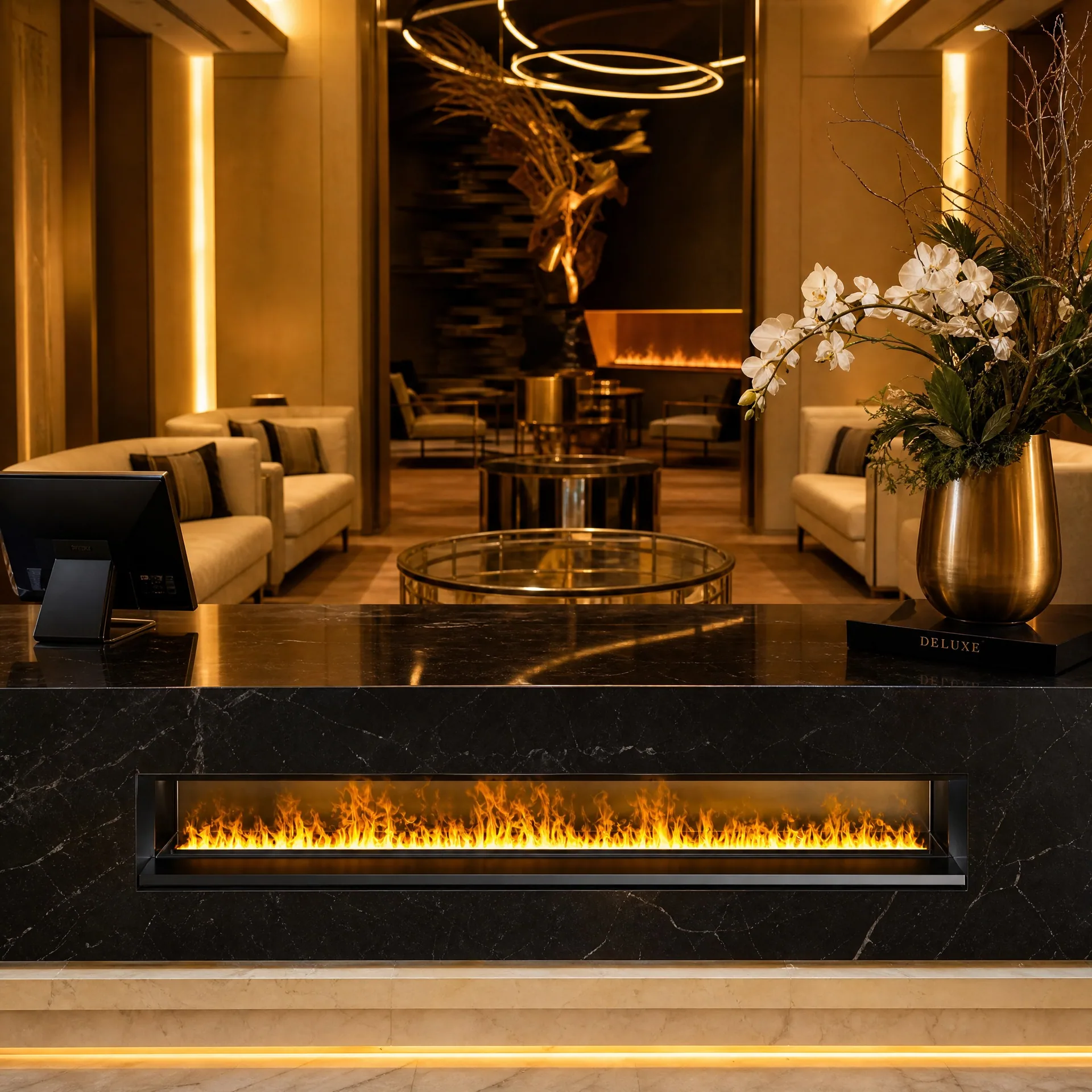
Evidence boundary: this guide provides a screening and monitoring method. It does not promise a fixed relative-humidity increase. SEFIRE Primary and Deluxe catalog water-consumption values are used only as equipment inputs; the result in a building must be established from the actual room, climate, ventilation, controls, and operating schedule.
Direct answer
Water vapor fireplaces can add moisture to indoor air, but the amount retained in the room is not automatically equal to the amount of water the appliance consumes. Water may become suspended mist, evaporate, condense on internal or nearby surfaces, return to a reservoir, be captured by drainage, or be removed by ventilation and air-conditioning. Relative humidity also changes when air temperature changes, even if the absolute quantity of water in the air remains constant.
For that reason, a claim such as "this fireplace raises humidity by 5 percent" is not credible without a defined room volume, starting temperature and humidity, ventilation rate, outdoor conditions, HVAC state, operating duration, measurement location, and equipment configuration. The same appliance may produce no meaningful change in a large conditioned lobby and a noticeable change in a small, closed, cool room.
The correct project method has three parts: establish a conservative moisture-input boundary from the exact model; evaluate the building's ability to remove moisture; and monitor the completed installation under realistic operating conditions. This gives designers and operators a defensible answer instead of a generic assurance.
Water consumption is an input, not the final humidity result
SEFIRE's verified Primary VSFB catalog lists six linear models from 750 to 2000 mm with water-consumption values from 0.2 to 0.8 liters per hour. The Deluxe VSFB catalog lists nine models from 750 to 2750 mm with values from 0.2 to 1.1 liters per hour. Those figures are useful for reservoir sizing, water-service planning, and a conservative moisture-load screen. They are not direct predictions of room relative humidity.
For a first-pass upper bound, one liter of water can be treated as approximately one kilogram, or 1,000 grams, of water. If a model consumes 0.5 L/h and every consumed drop is assumed to enter and remain in the room air, the theoretical upper-bound input is approximately 500 grams per hour. If it operates for four hours, the input boundary is approximately 2,000 grams. This is deliberately conservative: it does not subtract internal recovery, surface deposition, condensation, ventilation, or mechanical dehumidification.
Do not divide that number by room volume and call the result relative humidity. Relative humidity is the ratio between the water vapor present and the maximum the air can hold at the same temperature. Warmer air can contain more water vapor before reaching saturation. A cool glass surface may reach its dew point even while the average room sensor reports a moderate value. A reliable design therefore considers both the bulk room condition and local cold surfaces.
A simple room moisture balance
A project engineer can frame the problem as a moisture balance without pretending to know more than the available data supports:
Change in stored indoor moisture = fireplace moisture input + people and other sources + outdoor-air moisture input - ventilation exhaust - HVAC removal - drainage or condensation losses.
Each term can change over time. A hotel lobby may have doors opening, a variable outdoor-air system, many occupants, and air-conditioning that removes moisture. A residential media room may have intermittent ventilation and a closed door. A coastal project may start with humid outdoor air; a heated winter interior may start dry. The fireplace is one term in that system, not the entire system.
For early selection, classify the room rather than guessing a percentage:
| Room condition | Moisture concern | Project response |
|---|---|---|
| Large mechanically conditioned lobby | Often lower, but depends on HVAC operating mode and outdoor air | Confirm dehumidification and test during occupied conditions |
| Small room with closed doors and limited air change | Higher potential for accumulation | Use shorter cycles, provide ventilation, and log humidity |
| Cool glazing or exterior wall near the feature | Local condensation can occur before room average appears high | Check surface temperatures and inspect during cold weather |
| Pool, spa, or already humid hospitality space | Existing moisture load may dominate | Require mechanical-engineer review and explicit dew-point control |
| Display used briefly in a ventilated showroom | Intermittent contribution | Document operating schedule and monitor peak events |
Five variables that change the result
1. Model and operating time
The exact catalog consumption rate matters, but operating time matters just as much. A 20-minute demonstration and an eight-hour hospitality schedule are different design cases. Use the maximum intended daily runtime in the screening calculation, then verify it with the controls and operating procedure delivered to the site.
2. Room volume and air mixing
A larger air volume generally dilutes a given moisture input, but volume alone does not guarantee good performance. Mist may remain concentrated around the outlet if air movement is weak or may be carried toward a cold wall by a supply diffuser. Coordinate the fireplace outlet, nearby return grilles, supply jets, ceilings, recesses, and decorative screens.
3. Ventilation and dehumidification
Outdoor-air systems can either remove or add moisture depending on climate and treatment. Air-conditioning can remove latent moisture while cooling; heating without humidification may reduce relative humidity. Ask the mechanical engineer for the actual mode during fireplace operation rather than assuming that "the room has HVAC" resolves the issue.
4. Temperature and surface dew point
Average room relative humidity is only one indicator. Single glazing, metal trim, poorly insulated exterior walls, and cold stone can have lower surface temperatures. Condensation on a nearby television, cabinet, glass panel, or wall finish is a local failure even if the central building sensor looks acceptable.
5. Other moisture sources
People, cooking, wet cleaning, indoor plants, open doors, fountains, showers, and construction moisture may exceed the fireplace contribution. Record these sources during testing. Otherwise a project may blame the fireplace for a condition that began before it operated, or overlook an effect that appears only when several sources coincide.
Use a measured commissioning protocol
A practical test does not require a research laboratory, but it does require consistency. Use calibrated or at least cross-checked temperature and relative-humidity loggers. A single decorative wall display that has never been compared with another instrument is weak evidence.
- Record the baseline. Log temperature and relative humidity for 24 to 72 hours before operation if the programme allows. Include the same HVAC schedule, doors, occupancy, and cleaning activities expected during the test.
- Place sensors deliberately. Use one sensor in the occupied zone away from direct mist and supply air, one near the fireplace but outside the mist outlet, and one near the most vulnerable cold surface or electronic assembly. Record the positions.
- Define the operating event. State model, water condition, fill level, flame-effect setting, start and stop time, doors and windows, HVAC mode, outdoor weather, and occupancy.
- Run a realistic cycle. Test the expected daily duration, not only a five-minute demonstration. For frequent-use projects, repeat the cycle over several days and include the most humid anticipated season where possible.
- Inspect surfaces. Look for visible droplets, fogging, damp joints, changes around vents, and moisture near televisions, timber, textiles, metal, glazing, and electrical equipment.
- Review recovery. After shutdown, measure how long the room takes to return toward baseline. Slow recovery can indicate inadequate ventilation or an operating schedule that accumulates moisture.
- Set an operating rule. Define acceptable conditions, maximum runtime, ventilation state, inspection frequency, and the action to take if readings or visible condensation exceed the project criteria.
The U.S. Environmental Protection Agency states in general indoor-air guidance that indoor relative humidity should be kept below 60 percent and ideally between 30 and 50 percent. Treat this as broad building guidance, not a SEFIRE operating limit and not a replacement for the local mechanical design, climate-specific condensation analysis, museum or hospitality criteria, or the product manual.
Water quality changes maintenance and airborne residue
Ultrasonic atomization can make water quality visible. Minerals can deposit on transducers, tanks, baffles, glass, and nearby surfaces. The EPA notes, in guidance about portable ultrasonic and impeller humidifiers, that these devices can disperse minerals from tap water and recommends low-mineral water and regular cleaning. A water vapor fireplace is not automatically the same product category, so that guidance should be used to understand the mechanism, not copied as a universal product instruction.
Follow the current manual for the exact model. Do not publish a blanket claim that all locations can use untreated tap water or that every model requires distilled water. Water hardness, chlorides, treatment chemicals, filtration, standing time, reservoir construction, automatic fill components, and service interval all matter. For commercial projects, obtain a local water analysis when scaling is likely and agree the treatment and cleaning method before handover.
Primary uses manual filling and draining, so the enclosure must allow operators to handle water without wetting adjacent finishes. Deluxe supports automatic water service, but an automatic connection still needs isolation, drainage, access, leakage management, and a maintenance plan. Automation changes the work; it does not remove it.
Design details that reduce moisture problems
- Keep the mist outlet clear and use the model-specific opening and ventilation drawing.
- Avoid shelves, deep projections, or trim that trap mist immediately above the outlet unless the tested configuration allows them.
- Coordinate televisions, speakers, sensors, artwork, and electrical equipment with both airflow and manufacturer requirements.
- Provide service access for the reservoir, transducers, fans, lighting, filters, drains, and electrical connections.
- Use moisture-tolerant adjacent finishes where the design risk warrants them, while recognizing that a moisture-resistant finish does not fix poor ventilation.
- Provide a safe drain and overflow strategy for automatic-water configurations.
- Write the expected operating schedule into the handover documents so later staff do not turn an intermittent display into continuous operation without review.
Claims a buyer should reject
Reject a universal claim that a mist fireplace "does not affect humidity." Atomized water is present, so the effect must be evaluated. Also reject a universal claim that it "acts as a humidifier." A decorative fireplace has not necessarily been designed, controlled, tested, or rated to maintain a target indoor humidity. Both statements replace measurement with marketing.
Ask the supplier for the exact model's water consumption, water system, electrical load, dimensions, installation drawing, access requirements, cleaning instructions, and control description. Ask the mechanical designer to assess room conditions. Then commission the completed system. This division of evidence is more reliable than demanding one simple number from a catalog.
Specification and handover checklist
- Exact series and model, not only a target visual length
- Catalog water-consumption rate and intended daily runtime
- Manual or automatic fill and drain arrangement
- Room volume, ventilation mode, HVAC schedule, and climate design condition
- Nearby cold surfaces, electronics, timber, fabrics, art, and sensitive finishes
- Water-quality requirement, treatment, cleaning method, and service interval
- Baseline and operating sensor locations
- Project humidity and condensation acceptance criteria
- Action if visible condensation or unacceptable readings occur
- Responsible party for maintenance records and consumable or spare parts
Related SEFIRE resources
- Compare SEFIRE 3D water vapor fireplace series
- Primary VSFB manual-water series and verified model table
- Deluxe VSFB automatic-water series and verified model table
- Water vapor fireplace transducer and maintenance guide
- Water vapor fireplace installation planning
- SEFIRE technical data and corrections policy
Primary references used
- U.S. EPA: indoor humidity and particulate-matter source guidance
- U.S. EPA Mold Course, Chapter 2: moisture and humidity
- U.S. EPA: use and care of home humidifiers
Source interpretation: EPA references provide general indoor-environment and ultrasonic-humidifier guidance. They do not test, approve, or rate a SEFIRE fireplace. Model data comes from the current SEFIRE product pages and must be confirmed in the quotation and manual for the ordered configuration.
FAQ
Will a water vapor fireplace make a room damp?
It can contribute to damp conditions if the moisture input, operating time, room size, temperature, ventilation, and existing moisture sources combine unfavorably. It may have little measurable effect in a large conditioned space. Measure the actual room and inspect local cold surfaces rather than relying on a universal answer.
Can I calculate a percentage increase from liters per hour?
No. Liters per hour can support an upper-bound mass input, but relative humidity requires temperature, room air mass, starting moisture, ventilation, HVAC removal, and time. Surface condensation also depends on local surface temperature and dew point.
Should the fireplace be placed below a television?
Only after coordinating the fireplace outlet and access with the television manufacturer's environmental, temperature, and mounting requirements. Use the exact product drawing and verify conditions during commissioning. A visually attractive elevation is not sufficient evidence.
Does Deluxe eliminate humidity concerns because it drains automatically?
No. Automatic fill and drain change water handling, but the visible effect still uses atomized water. The room moisture balance, local surfaces, water quality, and maintenance remain relevant.
What should an operator do if condensation appears?
Stop or reduce operation, confirm ventilation and HVAC state, inspect for blocked airflow or incorrect installation, dry vulnerable surfaces, record the conditions, and have the project team investigate before resuming the same schedule. Do not treat visible condensation as normal decoration.
Editorial method and corrections
This page was substantially rewritten after a content-quality audit found that the earlier version relied on a repeated article template and did not clearly separate consumption from room humidity. The revision uses a moisture-balance framework, identifies the limits of calculation, and links model statements to the verified Primary and Deluxe tables. No fixed humidity increase has been invented.
For a correction, source request, or model-specific water-consumption document, email sales@sefireplace.com with the page URL, model, project location, and the statement to be reviewed.
Need a water vapor fireplace moisture plan?
Send the room dimensions, model or target length, daily runtime, HVAC information, nearby materials, water quality, and project country. SEFIRE can provide the model data and installation information your designer needs for a site-specific review.
Request Project Documents