SEV Product Engineering
How the SEV smart ethanol vapor fireplace works
The new SEV is a powered, real-flame ethanol system that separates liquid-fuel storage and delivery from the flame line, then uses a controlled startup, five flame levels, local monitoring, and multi-condition protection logic. This guide explains the operating cycle, project scenarios, display and alarm functions, fuel-use planning, controls, protection measures, and the differences between SEV and competing fireplace technologies.
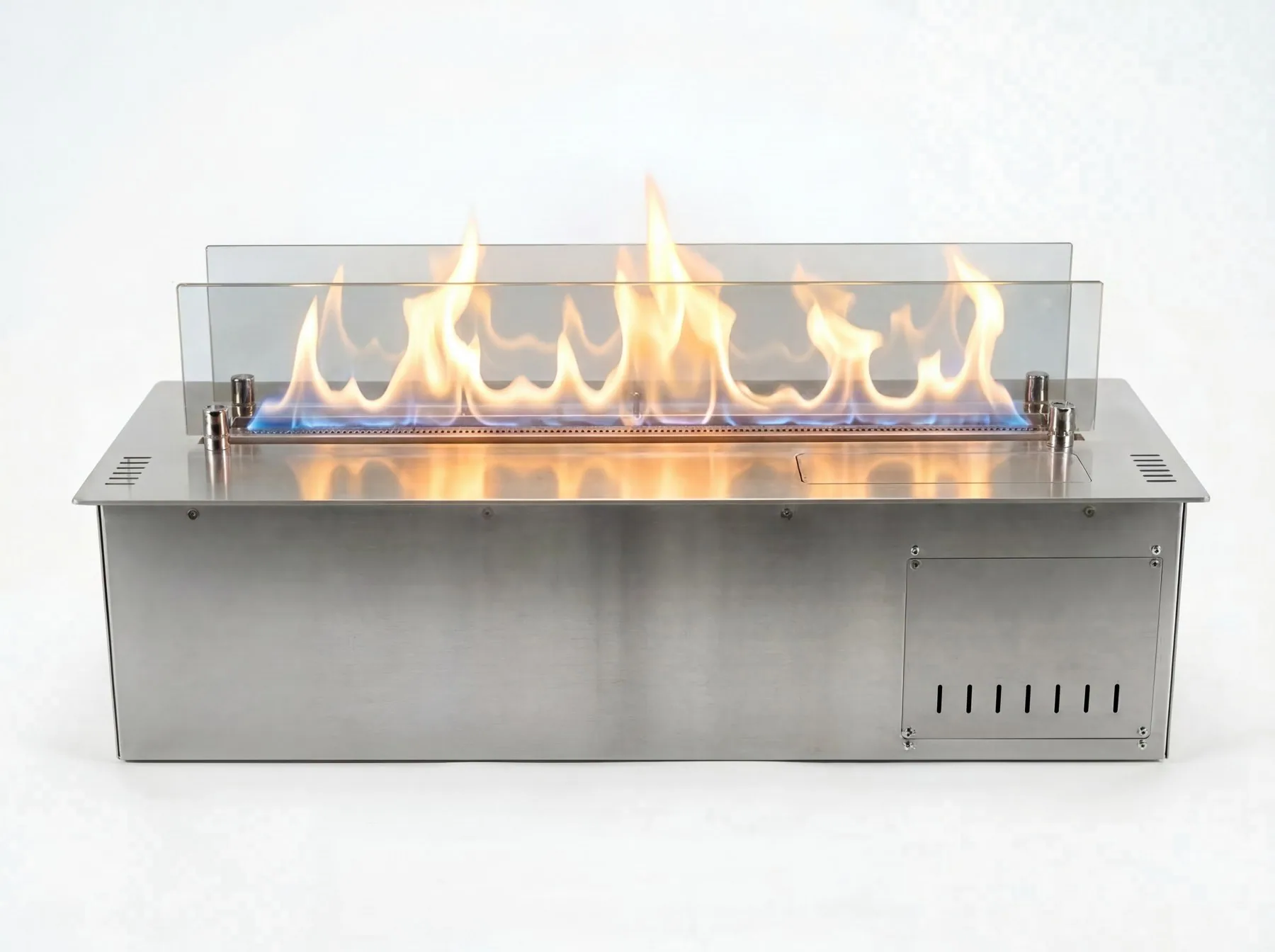
Direct answer: what makes SEV different?
SEV is best understood as an automatic ethanol-vapor fireplace platform. Approved liquid ethanol is stored and metered inside the appliance, but the intended combustion process occurs at the controlled burner line after the startup sequence prepares the fuel. The user does not light a tray of exposed liquid with a handheld lighter. Instead, the system performs a self-check, preheats, ignites, stabilizes the flame, and then allows adjustment from L1 to L5.
This distinction matters. A powered vapor-combustion system can coordinate fuel delivery, ignition, flame adjustment, alarms, shutdown, and cooling in ways that a basic manual burner cannot. It does not make fire risk disappear, and it does not remove the need for ventilation, clearances, supervision, fuel discipline, or local approval. It changes how those risks are managed.
Data confidence: The six-model dimensions, tank capacities, nominal run-time ranges, heat-output ranges, 110-240V supply, five flame levels, control methods, and alarm groups are documented in current SEV family materials. Draft sources contain inconsistent electric-power and flame-height summaries, so this article deliberately does not present one universal wattage or exact flame-height figure as a confirmed family specification.
1. Working principle: from liquid fuel to controlled real flame
The operating sequence is more useful to buyers than a broad phrase such as “smart fireplace.” The current SEV manual describes the following functional chain:
- Fuel is loaded through the designated inlet. The current specification calls for ethanol or bioethanol at 95% concentration or above. Gasoline, automotive ethanol, fragrance oil, mixed fuels, and unapproved liquids are excluded. Fuel should never be poured into the burner channel.
- The unit performs a local self-check. Fuel condition, temperature logic, tilt or vibration state, and other monitored conditions must permit startup. A remote command cannot turn an unsafe condition into an acceptable one.
- The controlled fuel system prepares the operating quantity. Internal pumping and preheating support the vapor-combustion process. This is why SEV requires electrical power even though the visible energy source is ethanol.
- Electronic ignition starts the flame at the linear outlet. Startup can take several minutes depending on model, fuel, and ambient temperature. The current control logic includes an initial protection period of approximately five minutes during which flame-level adjustment is unavailable.
- The controller maintains the selected level. After the startup lock, the operator can choose L1 through L5. The system coordinates the operating state rather than relying on a manually opened fuel slot.
- Shutdown stops fuel delivery before cooldown. Residual prepared fuel is allowed to burn off, after which the unit enters cooling protection. Refilling, touching hot parts, or moving the appliance during this period is not permitted. The current manual recommends at least 30 minutes of cooling before refueling or service interaction.
The correct mental model is therefore not “a tank with a flame above it.” It is a sequence of storage, metering, preparation, ignition, monitored combustion, controlled shutdown, and cooling. Planika describes a comparable category principle in its official BEV technology explanation: ethanol is heated and the vapor is burned without direct flame contact with the liquid. SEV belongs to the same broad automatic vapor-combustion category, but it is a separate product platform with its own construction, controls, model data, and approval requirements.
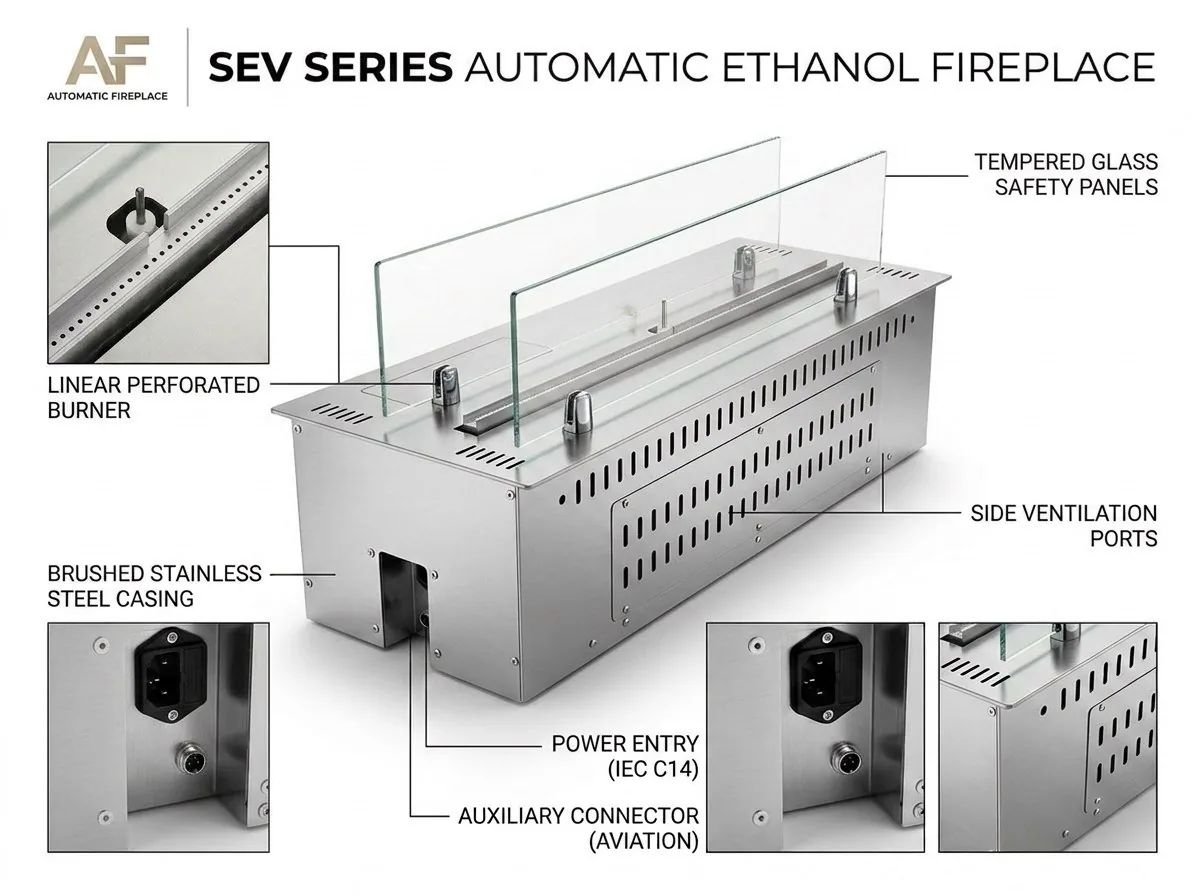
2. Where SEV fits: working scenarios and operating responsibility
SEV is primarily a decorative real-flame feature with useful heat output. It should not be sold as the sole or continuous heating system for a building. Its strongest applications are projects that want a real flame, a long linear format, repeatable controls, and a more structured operating routine than a manual burner provides.
Private villas and premium residences. SEV can support media walls, long stone features, room dividers, and open-plan living areas where the owner wants authentic flame and adjustable visual intensity. The design team must still coordinate combustible materials, glazing, furniture distance, air movement, fuel storage, and a service opening.
Hotel lounges and controlled hospitality spaces. Staff operation is a better fit than unrestricted guest operation. The handover should identify who starts the unit, who watches it, who shuts it down, where approved fuel is stored, and how alarm codes are escalated. A beautiful installation with no operating owner is an incomplete project.
Showrooms and distributor displays. The five levels let sales teams demonstrate flame variation and explain the difference between manual ethanol, automatic vapor-combustion, and water-mist systems. Demonstration units need the same supervision and cooldown discipline as customer installations.
Architectural and interior-design projects. The six standard lengths share a nominal 300 mm depth and 220 mm body height in current family data, which helps early wall-section planning. Exact clearances and finishing details are not interchangeable between models or markets; request the selected model drawing before releasing millwork or stone.
SEV is a poor fit where users expect unattended operation, where the room cannot provide the required conditions for a real-flame appliance, where fuel handling cannot be controlled, or where a cold decorative effect is sufficient. In those cases, a 3D water vapor fireplace or another non-combustion visual system may be the more rational choice.
3. Device monitoring: what the operator can actually see
The local panel is the primary operating reference. Current SEV controls show fuel level, operating time or mode information, flame level, and alarm status. Physical ON/OFF, UP, and DOWN controls allow the operator to start, stop, and adjust the unit without depending on a phone or cloud connection.
The manual describes a seven-sensor protection system covering conditions such as temperature, fuel level, vapor concentration, tilt, and vibration. The useful point is not the sensor count by itself. The value comes from the controller turning sensor information into actions: allow startup, delay adjustment, stop fuel delivery, block restart, or display an alarm.
| Alarm group | Current manual examples | Operator response |
|---|---|---|
| Control and communication | 01 storage-chip fault; 02 Wi-Fi module fault | Use the manual procedure and contact service if the code remains; do not assume app failure means local protection is disabled. |
| Environment and movement | 10 high-CO2 alarm label; 11 vibration or tilt | Stop use, ventilate or inspect the site condition, and correct instability before restart. |
| Ignition and flame | 12 no flame after ignition; 13 ignition timeout | Do not repeat uncontrolled ignition attempts. Check fuel, conditions, and service guidance. |
| Fuel system | 20 low fuel; 21 high fuel; 22 fuel leak | For leak or overfill indications, stop operation and follow the manual. Never add fuel to override an alarm. |
| Temperature system | 30, 40-42, and 50-53 cover thermal protection, sensor faults, excessive tray temperature, restart blocking, and tank-temperature conditions | Allow cooling and obtain technical support when required. Temperature lockouts are not inconvenience settings to bypass. |
A connected app can make status and commands more convenient, but the local display remains critical during commissioning and troubleshooting. Buyers should ask suppliers for a short alarm-code sheet in the destination language and train staff to photograph the code before cycling power.
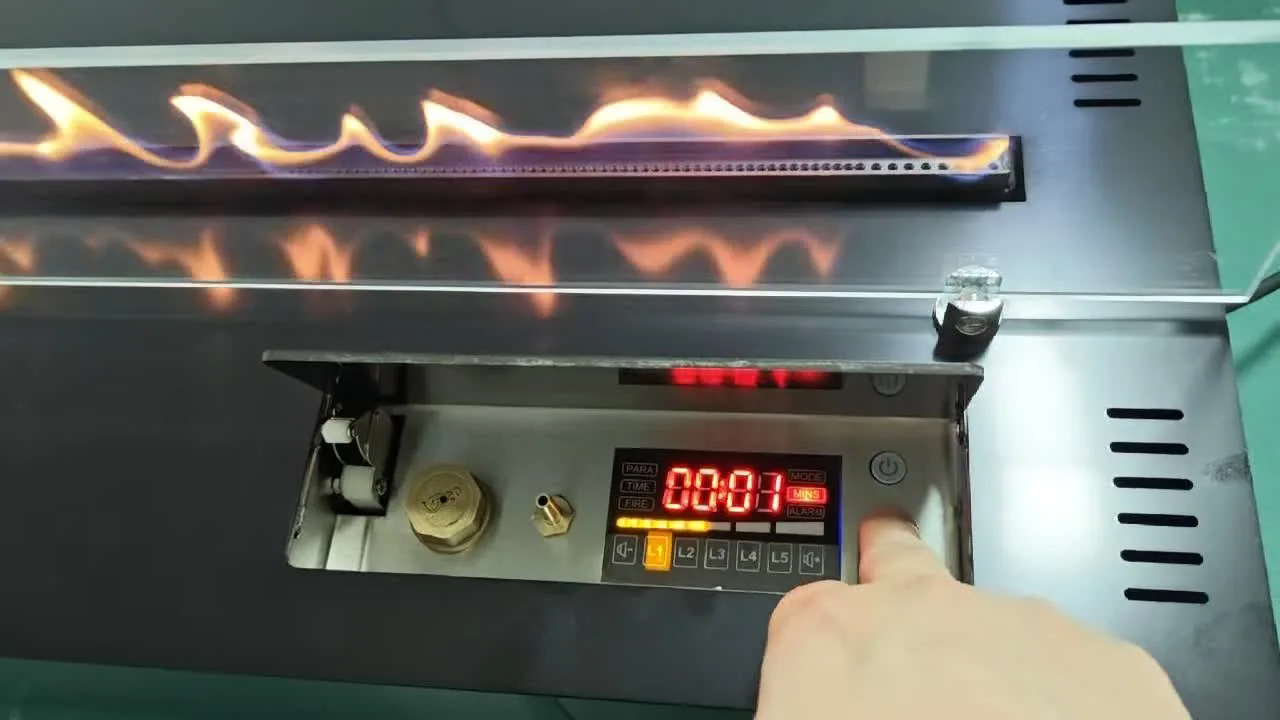
4. Five flame levels: what L1 to L5 change
After the startup protection period, UP and DOWN move through L1, L2, L3, L4, and L5. Lower levels are intended for a smaller visual flame and generally longer operation from a given tank; higher levels create a more forceful flame presentation and generally consume fuel faster. They also change the heat contribution and the visual relationship between flame, glass, wall finish, and viewing distance.
The level should be selected for the actual room, not simply left at maximum. In a close-view residential setting, L2 or L3 may provide a calmer line. A large showroom or hotel lounge may use a higher level for a stronger visual focal point, subject to room and installation conditions. Outdoor drafts, strong HVAC flow, and open doors can change flame appearance; level adjustment is not a substitute for correcting a poor site condition.
Do not publish one universal “L1 equals X liters per hour” claim unless the exact model has been tested under a defined protocol. The current family data provides tank capacity and an overall nominal run-time range, but not a certified per-level consumption curve for every length. Procurement teams should request a model-specific test record if per-level cost forecasting is contractually important.
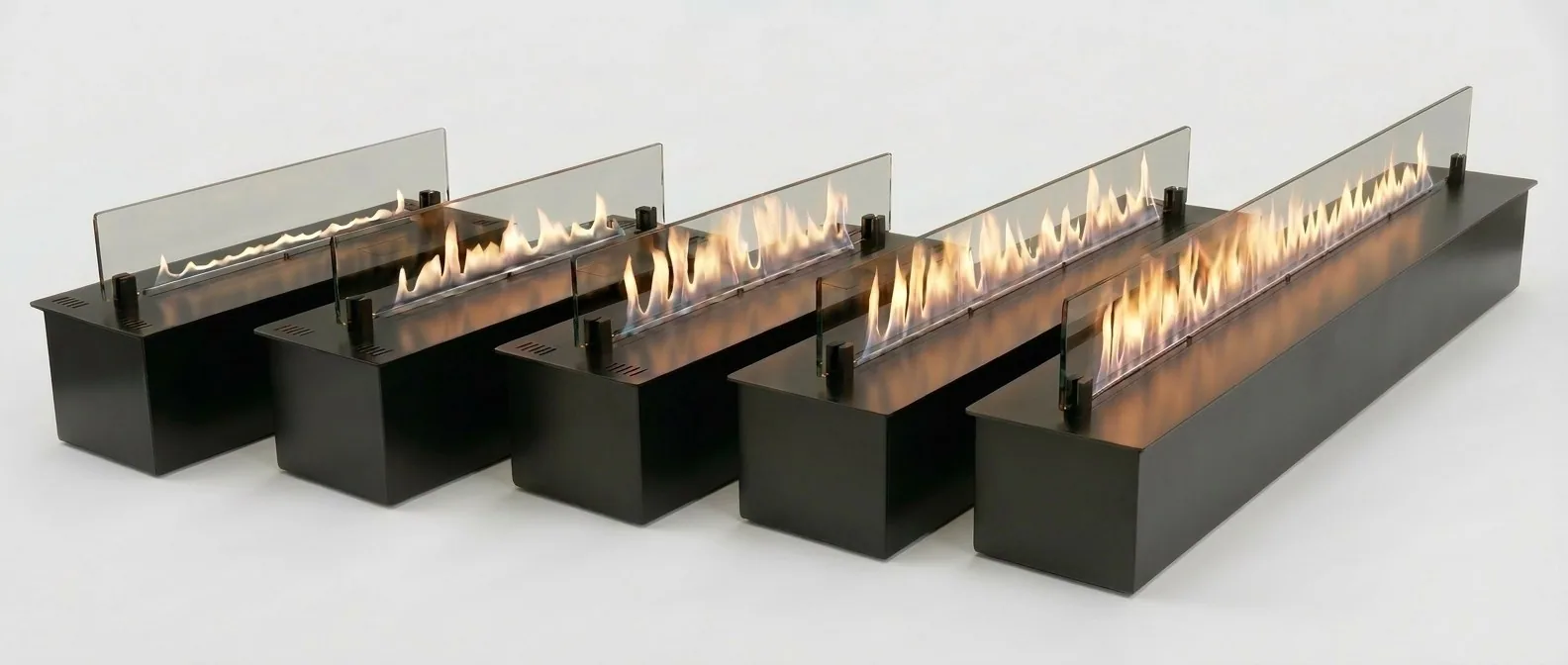
5. Fuel efficiency: use ranges, not marketing shortcuts
Fuel efficiency has at least three meanings: liters consumed per hour, useful heat delivered, and visual effect per operating cost. Those are not the same metric. SEV produces real heat, but it is positioned as a decorative fireplace. A buyer selecting it only by the highest kilowatt number is ignoring control, flame presentation, room conditions, and operating responsibility.
The table below calculates an implied average consumption envelope by dividing each documented tank capacity by the ends of its nominal run-time range. This is an inference for budgeting, not a guaranteed L1 or L5 laboratory result.
| Model | Tank | Nominal run time | Nominal heat range | Implied average fuel-use envelope* |
|---|---|---|---|---|
| SEV-750 | 2.5 L | 6-10 h | 2-6 kW | about 0.25-0.42 L/h |
| SEV-1000 | 4.0 L | 7-12 h | 3-7 kW | about 0.33-0.57 L/h |
| SEV-1250 | 6.0 L | 7-12 h | 3-8 kW | about 0.50-0.86 L/h |
| SEV-1500 | 7.0 L | 8-12 h | 4-9 kW | about 0.58-0.88 L/h |
| SEV-1750 | 8.5 L | 8-14 h | 5-10 kW | about 0.61-1.06 L/h |
| SEV-2000 | 9.5 L | 8-14 h | 5-11 kW | about 0.68-1.19 L/h |
*Calculated from capacity divided by the published maximum and minimum run times, rounded to two decimals. Actual consumption varies with level, fuel, startup and shutdown cycles, ambient conditions, installation, and production configuration.
For operating-cost planning, multiply a realistic liters-per-hour assumption by the delivered fuel cost in the project country, then test sensitivity at low and high use. Frequent short cycles can produce a different cost profile from one long stabilized run. The broader method is explained in our ethanol fireplace fuel-consumption guide.
6. Control methods: local first, connected second
Current SEV configurations support a touch panel, remote control, and Wi-Fi app functions; Tuya Smart and Google Home support depend on the ordered configuration and destination setup. Tuya's official documentation describes app-based device status and control capabilities, but the exact data points exposed by a product are defined by that product's implementation. Buyers should therefore verify the actual SEV app screen and available commands rather than assuming every generic Tuya function is included.
A sensible authority hierarchy is:
- Local protection logic decides whether operation is permitted.
- Physical controls provide commissioning and fallback operation at the appliance.
- Matched remote control provides line-of-use convenience.
- App or smart-home interface sends permitted commands and displays supported status.
Network loss should not erase local safety functions. Voice control also requires special caution because a spoken command can be issued without a direct view of the fireplace. For hotels and shared spaces, app-account ownership, staff permissions, Wi-Fi changes, handover, and account recovery should be written into the operating plan. See our smart-home ethanol fireplace integration guide for commissioning questions.
7. Protection measures: what smart safety can and cannot do
The SEV protection architecture addresses fuel level, tilt and vibration, vapor concentration, ignition outcome, flame state, and multiple temperature conditions. It can block startup, hold flame adjustment, stop fuel delivery, prevent a hot restart, and show alarms. These are meaningful engineering controls. They are not permission to ignore the operating manual.
- Use only the approved ethanol grade and designated filling route.
- Do not add fuel to the burner line, bypass an alarm, or continue after a leak indication.
- Keep the appliance stable and the required ventilation openings clear.
- Supervise real-flame operation; smart control does not mean unattended fire.
- Complete the shutdown and cooling period before refueling, moving, covering, or servicing the unit.
- Follow the exact delivered clearances, drawing, local code review, and fire-safety plan.
The U.S. CPSC's 2024 consumer alert concerns pooled-alcohol fire pits rather than SEV, so it should not be misapplied as a product finding. It is still relevant evidence for why liquid-fuel handling is serious: the agency highlights pool-fire and flame-jetting hazards when users pour fuel into open containers or refill in the presence of flame. An automatic enclosed fuel path and controlled cooldown reduce opportunities for that specific user behavior, but only when the product is installed and operated as designed. Review the CPSC alcohol fire-pit alert and our bioethanol fireplace safety checklist.
8. Competitor and technology comparison
A fair comparison separates operating principles instead of ranking photographs. Planika represents automatic ethanol-vapor combustion; EcoSmart Fire documents a traditional ethanol burner ecosystem in which the burner chamber houses fuel and safe manual procedures are central; Dimplex Opti-myst represents ultrasonic water mist illuminated to create a three-dimensional flame effect. These are not identical substitutes.
| Technology route | Visible effect | Control and monitoring | Fuel or utility | Best fit | Key trade-off |
|---|---|---|---|---|---|
| SEFIRE SEV Automatic ethanol-vapor combustion | Real adjustable flame and real heat | Local panel, remote, optional app/smart-home functions, five levels, sensor and alarm logic | Approved ethanol plus electrical supply | Premium residential, hospitality, showroom, and controlled architectural projects | Requires fuel management, power, supervision, clearance planning, and service access |
| Planika BEV category Automatic ethanol-vapor combustion | Real flame and heat | Model-dependent electronic controls and automation | Brand-specified ethanol plus electrical supply | Buyers seeking established premium automatic vapor-burner products | Compare model evidence, size, control scope, certification, service network, and total cost; do not assume two vapor systems are technically identical |
| Traditional/manual ethanol burner category EcoSmart Fire is one documented example | Real flame and heat | Typically more operator-led; exact controls depend on model | Specified bioethanol; some designs do not need mains power | Projects prioritizing mechanical simplicity and flexible placement | Filling, lighting, adjustment, extinguishing, cooling, and refueling rely more heavily on trained user procedure |
| Dimplex Opti-myst / water-mist category Ultrasonic mist plus lighting | Three-dimensional simulated flame; no ethanol combustion | Electronic effect controls; heat is separate or model-dependent | Water and electricity | Public spaces, media walls, and projects prioritizing a combustion-free visual effect | No authentic ethanol flame; requires water quality, cleaning, airflow, and transducer maintenance |
| Conventional electric flame effect | Simulated flame; optional electric heater | Simple remote or app controls are common | Electricity only | Apartments and projects prioritizing easy operation | Visual depth and real-flame character vary; heater and flame effect are not equivalent to ethanol combustion |
Official category references: Planika BEV technology, EcoSmart Fire ethanol burner technology, EcoSmart Fire safety instructions, and Dimplex Opti-myst technology. These sources describe their own products; they do not certify SEV.
9. What a professional buyer should verify before ordering
- Exact model, body dimensions, finished opening, weight, tank capacity, and nominal run-time range
- Approved fuel specification and destination-market fuel availability
- Electrical connection, delivered plug or terminal method, and backup operating expectations
- Included control methods, app region, account ownership, smart-home functions, and remote quantity
- Alarm-code sheet, shutdown behavior, hot-restart protection, and staff/user training
- Installation clearances, ventilation openings, glass arrangement, service access, and finish interfaces
- Model-specific test video at more than one flame level, nameplate photo, packing evidence, spare parts, and after-sales route
- Certification or compliance documents that identify the exact model, standard, issuing body, and scope required by the destination market
For the six current sizes and verified family data, see the SEV product series page. To compare this platform with SEFIRE's standard smart ethanol line, review RCFB Regular. Do not transfer RCFB electrical, capacity, or dimensional data to SEV; they are separate families.
FAQ
Is the SEV a water vapor fireplace?
No. SEV uses controlled ethanol-vapor combustion to create a real flame and real heat. A water vapor fireplace uses illuminated mist to simulate a flame without combustion.
Does an SEV fireplace require electricity?
Yes. The SEV family uses a 110-240V AC, 50-60Hz supply for its control, fuel-delivery, preheating, ignition, display, and protection functions. Confirm the exact delivered configuration and local connection requirements.
Can an SEV fireplace run unattended?
No. Smart controls and protection logic do not make a real-flame appliance suitable for unattended operation. A responsible adult should supervise operation and follow the model manual and site rules.
Does L1 always provide the same burn time?
No. Burn time varies with model length, tank capacity, selected level, fuel quality, ambient conditions, installation, and operating cycle. Use the model range for planning and verify the final configuration rather than promising one fixed number.
Can app or smart-home control bypass the SEV safety system?
It should not. Remote interfaces are command methods; local control and protection logic remain responsible for accepting, delaying, or rejecting a command when the unit is in startup, alarm, shutdown, or cooling protection.
Need the SEV model table, drawings, or a test video?
Send the target length, country, installation drawing, quantity, control requirements, and intended operating environment. SEFIRE will identify the relevant SEV configuration and the documents that must be confirmed before production.
Request SEV specifications